HeadsUp, three months on: from a waitlist to open beta
The last time I wrote about HeadsUp, it was a coming-soon page and a waitlist. I ended that post by saying there was a lot of build between there and something you could send your friends. That gap closed faster than I expected, mostly because HeadsUp quietly ate every evening and weekend I had. Since that post the repo has picked up a little over 2,300 commits. This is the catch-up.
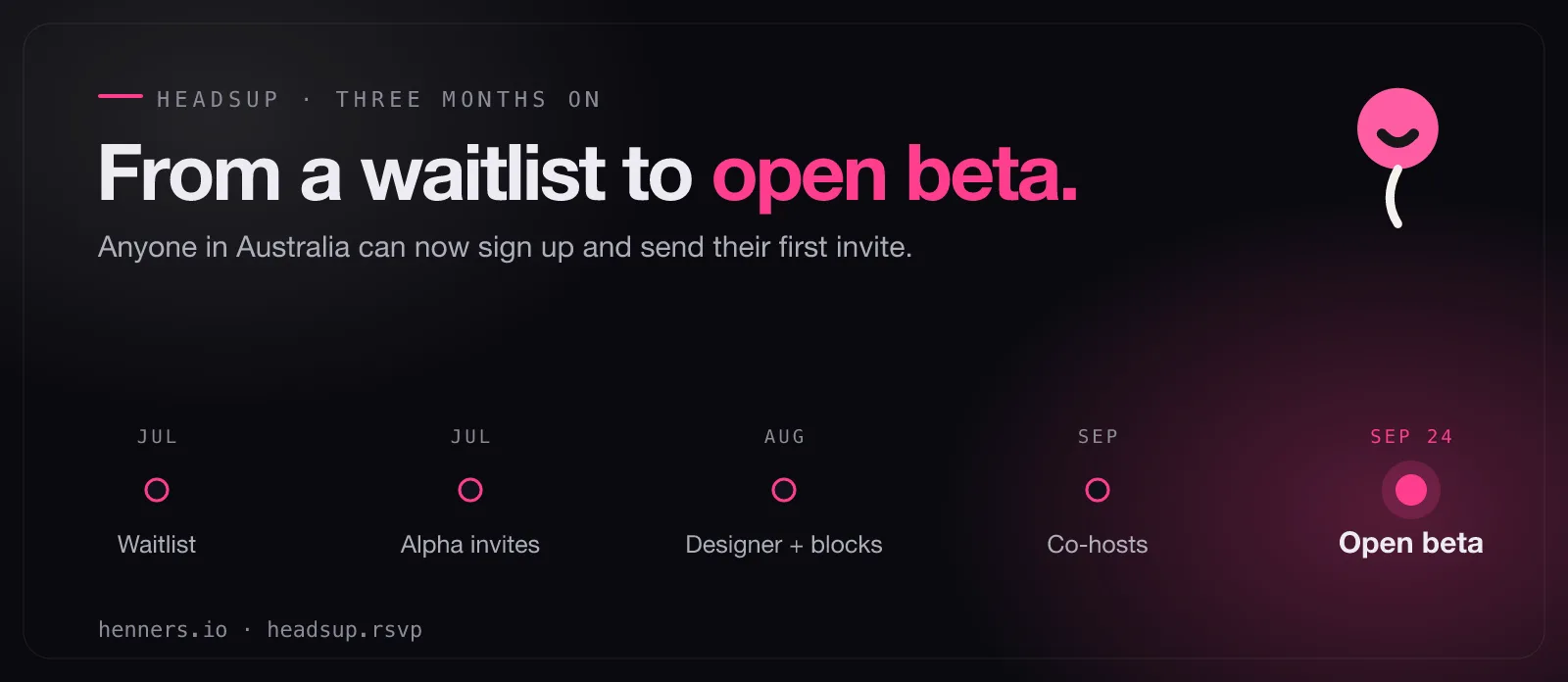
From a waitlist to open beta
The short version of the timeline: the real app went live at headsup.rsvp in mid July. A week later everyone on the waitlist got an alpha invite, with three months of Pro on the house as a thank you for being early. Around the same time I opened a live demo invite and the full editor to anyone, no account needed, so people could see what it was before deciding whether to care.
August was the busiest stretch. Guests got the ability to ask the host a question, bring a plus one, and add the event to their calendar. Hosts got an AI designer that drafts an invite from a sentence, and invites became interactive: polls, a bring-a-plate list, chip-ins for a shared gift, sign-up sheets. Then co-hosts, so two people can run the same event without passing a login around.
On September 24 open beta went live. Anyone in Australia can sign up and run an event, free, no card, no invite code, no waiting on me. A few days later the people who'd put up with me talking about RSVPs for months came round for a backyard launch party. The dress code was pink. Most of them honoured it.
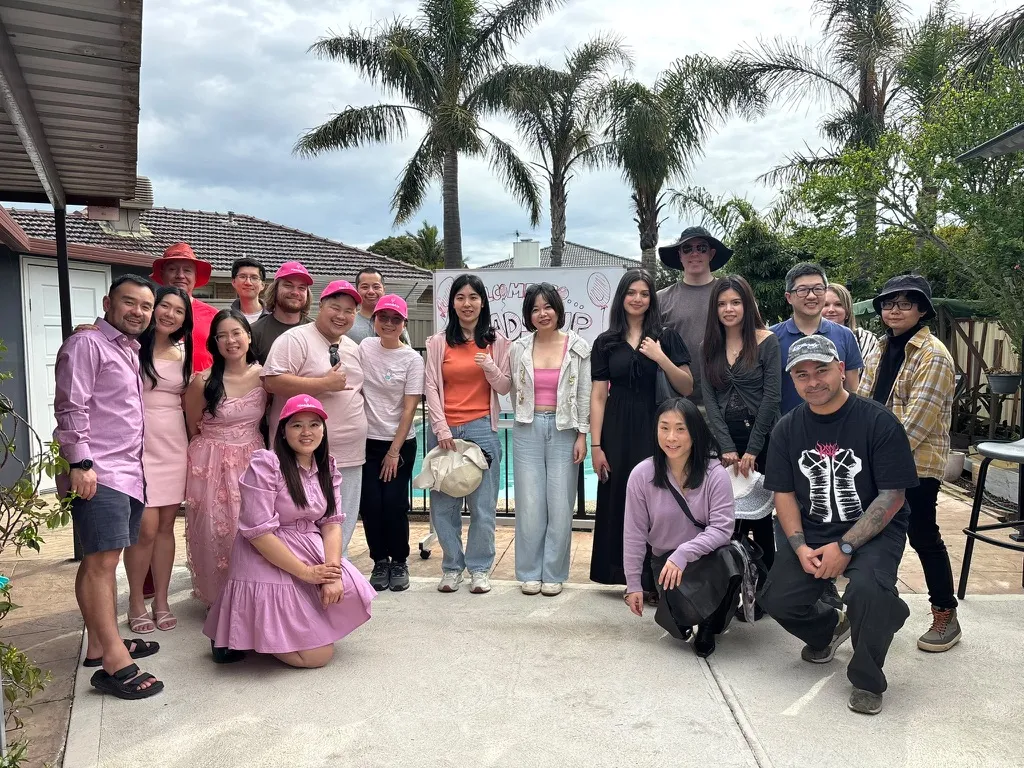
The sign was hand-drawn. The caps were not: a stack of pink HeadsUp caps did the rounds, and by the end of the afternoon they were on most of the heads in the selfies.
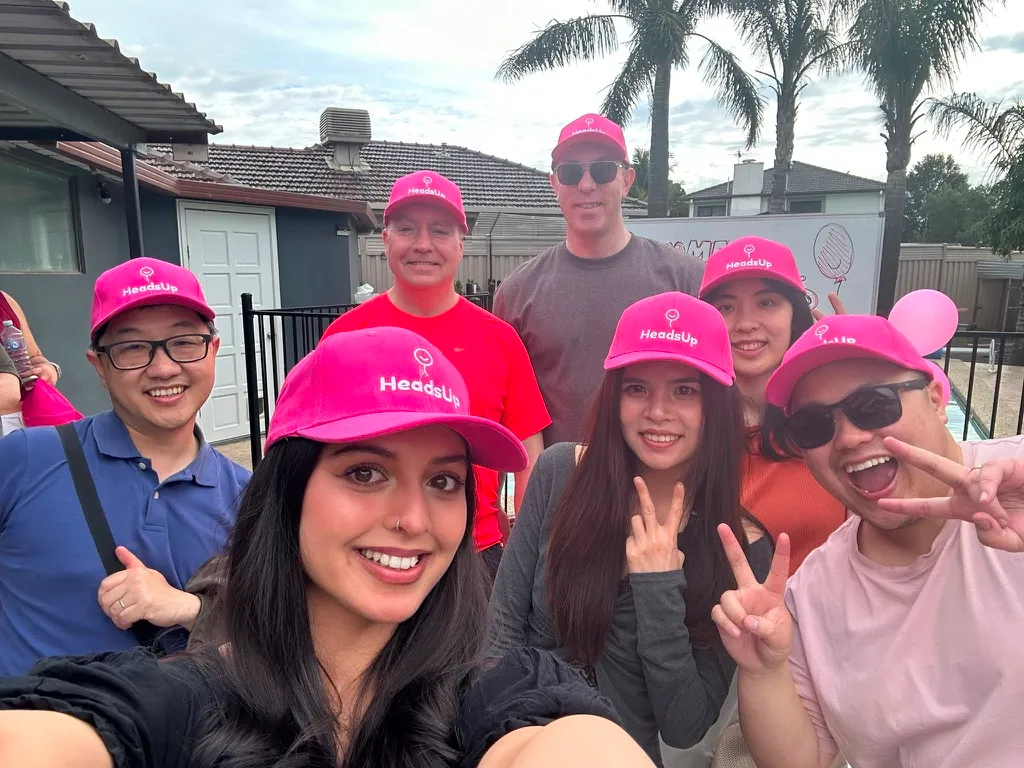
As the host, I held myself to my own dress code and then some: a pink HeadsUp hoodie, a pink wig, sunglasses, and a spot behind the barbecue for most of the afternoon. Someone had to man the sausages.

The bit I care about most
If I had to keep one feature, it's the reveal gate. Private details like your address or your PayID stay hidden on the invite until the guest verifies with a one-time code sent to them. A forwarded link doesn't hand your home address to a stranger. It was the reason I couldn't leave the idea alone back in July, and it's still the thing people react to first when I show them.
The rest is the boring-but-necessary stuff that makes the group chat obsolete. Every guest gets their own link, by text, from a sender that says "HeadsUp". You can see who has opened it and who hasn't, so you nudge the three people who need it and leave everyone else alone. RSVPs land in a live tally, and when plans change, an update reaches the people who need to know.
Things I changed my mind about
In the July posts I said HeadsUp would be free for everyone. That turned out to be half true. The free plan is properly free: three invites on the go, up to 150 guests each, sent by email and link, with the reveal gate working over email codes. But a text message costs me real money every time one goes out, so texts come in packs of 50, 200 or 500, and they don't expire. Plus and Pro plans start at $12.99 for 30 days, as a one-off pass or on renewal.
That split created its own problem. A free host who never bought a pack never saw texting work, which is arguably the best part of the product. So as of today, every account can claim 25 free texts once, by verifying an Australian mobile. It's sized to match a month of Plus, and the texts never expire either.
The other reversal was the app. On July 21 I wrote myself a fairly confident note: no native app, the mobile web app already is the mobile experience. A week later I scaffolded iOS and Android apps anyway.
What changed my mind was the list of things a website on a phone just can't do well. A browser tab can't tap you on the shoulder when someone RSVPs. It can't open your phone's contacts and let you tick twenty friends at once. It can't reliably use the camera to scan guests in at the door. Once I wrote down what hosts actually wanted from "an app", almost all of it was in that gap.
So the apps exist to add convenience, not to replace the website. Hosts get a push notification the moment a guest replies, asks a question, claims a sign-up slot or chips in. Adding guests is a multi-select pick from your contacts instead of typing numbers. On the night, Business hosts can scan each guest's QR code at the door with the camera. And the small things that quietly break inside an app, like printing the post-event report or saving the guest list as a spreadsheet, go through the phone's own print and share sheets.
The trick that made it worth doing as a one-person team is that the apps are a thin Capacitor shell whose web view loads the live site. Nothing is bundled, so the app updates the moment the website does, and app store review only ever gates the native wrapper and the handful of small plugins that give it contacts, push, the camera and the share sheet. One codebase, three surfaces. The iOS app has been in TestFlight with real testers since August. Android is built and waiting on its store listing.
Lately: getting found
Building the thing turned out to be the easier half. The last few weeks have been about getting it in front of people who don't follow me on LinkedIn. Earlier this month I shipped ten free tools on the site, no account needed: a Secret Santa draw, a group date poll, a bring-a-plate sheet, a party food calculator, a cost splitter, an invitation wording helper, a when to send invitations planner, a guest turnout calculator, place cards and name tags, and an event countdown. Each one is useful on its own, and each one sits next to the moment you'd want to send an invite.
With the silly season coming, there's also a Christmas party theme now, complete with fairy lights and baubles, and a corporate one for the work end-of-year.
What about Scaffy?
Honestly, it's paused. When I introduced HeadsUp I said I'd be juggling both, and that lasted about a week before HeadsUp won the fight for my time. Scaffy is MIT licensed and the repo stays up, and the build log on this blog isn't going anywhere. I'd like to come back to it. Right now, though, HeadsUp has real people using it, and that's hard to put down.
What's next
It's still a beta, which means rough edges, and I want to hear about every one of them. If you've got something coming up, a birthday, a dinner, a work Christmas party, it's free to host. And if you just want to poke at it first, the demo invite opens exactly the way a guest would see it, no account needed.